



Last Updated on July 15, 2026
All-Weather vs. All-Season Tires: The Complete Guide to Safe Fall Driving
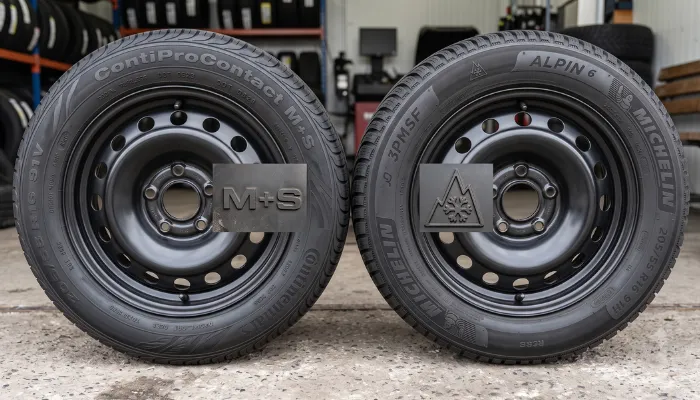
When it comes to the debate of All-Weather vs. All-Season tires, the primary difference lies in their rubber compound and winter testing certification. All-weather tires carry the 3-Peak Mountain Snowflake (3PMSF) symbol, meaning their rubber is engineered to stay flexible below 45°F (7°C) and provides verified traction in severe snow. All-season tires, typically carrying only the basic Mud and Snow (M+S) rating, are designed for three seasons (spring, summer, and fall) but harden into slippery “hockey pucks” in freezing temperatures. If your region experiences freezing weather and occasional snow, all-weather tires are the safer, more capable choice.
The Great Tire Marketing Myth: Decoding “All-Season”
For decades, the tire industry has relied on a naming convention that has left millions of drivers dangerously underprepared for winter driving. If you walk into a dealership or tire shop today, the default tire equipped on most passenger cars, SUVs, and even light trucks is the “All-Season” tire.
Logically, “all-season” implies year-round capability. However, in the automotive engineering world, all-season actually translates to three seasons. These tires are optimized for longevity, fuel efficiency, a quiet ride, and adequate performance in dry and wet conditions. But when the temperature drops, the chemical properties of their rubber compound betray their name.
To become an informed consumer, and to stay safe this fall and winter, you need to understand the fundamental engineering differences between standard all-season tires, the newer all-weather category, and dedicated winter tires. Not sure what tires your car is currently running? Head over to Tires Easy to easily search for factory matches by your exact vehicle make and model.
The Science of Rubber Compounds
The secret to tire grip isn’t just the tread pattern; it is the molecular structure of the rubber. Tires need to be soft enough to grip the microscopic imperfections in the asphalt, but firm enough to resist wearing out completely in a few thousand miles.
- Summer Tires: Designed for extreme heat, they become dangerously brittle in the cold.
- All-Season Tires: Designed for a moderate temperature range. Once the thermometer dips below 45°F (7°C), the silica and polymers in an all-season tire stiffen. As one Reddit user perfectly described it in a popular discussion within the r/tires community, driving on frozen all-season tires is like “driving on hockey pucks.”
- All-Weather & Winter Tires: Blended with higher ratios of silica and natural rubber, these compounds remain pliable and sticky even at sub-zero temperatures.
Want to dive deeper into tire anatomy before making a purchase? Check out our comprehensive guide on How to Read Tire Sizes and Sidewall Specs

What Are All-Season Tires? (M+S Explained)
All-season tires are the jack-of-all-trades, master of none. They usually come with an M+S (Mud and Snow) designation on the sidewall. To fully understand the gap between All-Weather vs All-Season tires, we first need to look at what the standard ‘all-season’ badge actually means
The Problem with the M+S Rating
It is crucial to understand that the M+S rating is not a performance standard; it is a geometric standard. According to the US Tire Manufacturers Association (USTMA), a tire can earn the M+S badge simply by having a tread pattern where the grooves make up at least 25% of the tire’s footprint.
- No Winter Testing Required: A tire can receive the M+S rating without ever touching a single flake of snow.
- Ideal Use Case: All-season tires are perfect for drivers in places like Florida, Southern California, or Texas, where winter means heavy rain but rarely freezing temperatures.
- Limitations: They offer poor braking distance on ice and minimal lateral grip in packed snow.
What Are All-Weather Tires? (3PMSF Explained)
All-weather tires are a relatively new category in North America, bridging the massive gap between all-season and dedicated winter tires. Think of them as high-performance all-season tires that have actually graduated from winter survival school.
The 3-Peak Mountain Snowflake (3PMSF) Certification
Unlike the M+S geometric rating, the 3PMSF (Three-Peak Mountain Snowflake) symbol is a performance-based certification. To earn this badge, a tire must undergo physical testing on medium-packed snow and demonstrate a minimum threshold of acceleration traction compared to a standard reference test tire.
- Year-Round Convenience: You do not need to swap them out when spring arrives. They are designed to survive summer heat while remaining safe in winter cold.
- Tread Design: They often feature a distinctive V-shaped directional tread pattern (like the Michelin CrossClimate 2) and heavy siping (tiny slits in the tread blocks that act like biting edges on ice).
- Trade-offs: Because they use a softer rubber compound than standard all-seasons, they might wear slightly faster during severe summer heatwaves and can be marginally louder on the highway.
Ready to equip your vehicle for unpredictable climates? Browse our curated selection of top-rated All-Weather Tires and ensure you have that crucial 3PMSF rating
Feature Comparison: All-Season vs. All-Weather vs. Winter Tires
To make the best decision for your vehicle, look at this side-by-side breakdown of capabilities. When comparing All-Weather vs. All-Season tires, along with dedicated winter options, the differences in safety become clear:
|
Feature / Tire Type |
Standard All-Season (M+S) | All-Weather (3PMSF) | Dedicated Winter (Studless) |
| Ideal Temperature | Above 45°F (7°C) | All Temperatures | Below 45°F (7°C) |
| Winter Certification | None (Visual M+S only) | 3-Peak Mountain Snowflake | 3-Peak Mountain Snowflake |
| Snow Performance | Poor to Fair (Light dusting) | Good (Moderate snow/slush) | Excellent (Deep snow/ice) |
| Ice Braking | Dangerous | Moderate/Safe | Superior |
| Summer Wear | Excellent (Long lasting) | Good (Slightly faster wear) | Poor (Will severely degrade the rubber) |
| Tire Swapping? | No | No | Yes (Requires a summer set) |
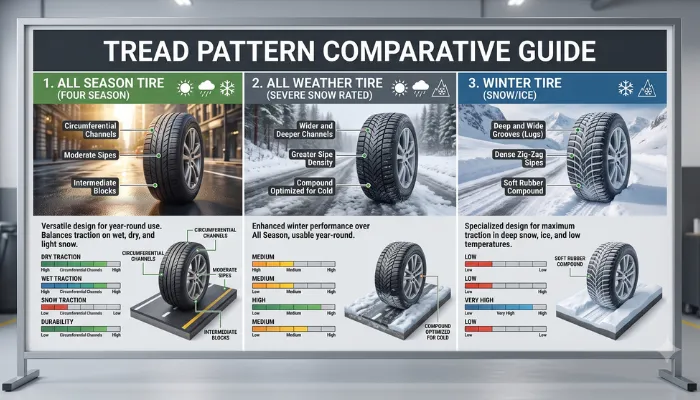
As you can see from the breakdown above, the performance gap between a standard all-season tire and a 3PMSF-rated tire becomes a critical safety factor the moment temperatures drop below 45°F. But how exactly do tire manufacturers achieve these drastically different results? The secret lies entirely in the engineering of the contact patch.
To truly understand why an all-weather tire safely grips slush and snow while a standard all-season tire simply slides, you have to look closely at their physical construction. As shown in the comparative guide below, the extreme differences in siping (the tiny zigzag slits), groove depth, and aggressive directional patterns are what ultimately keep your vehicle planted safely on the road.
Real Drivers, Real Questions: Insights from the Community
When analyzing real-world user-generated content from forums like Reddit, it becomes clear that marketing jargon leaves many drivers confused. By extracting the main concerns from the r/Rivian and r/tires communities, we can address the specific dilemmas drivers face today.
The Heavy EV Dilemma: Insights from r/Rivian
Electric vehicles (EVs) like the Rivian R1T and R1S are incredibly heavy and produce massive amounts of instant torque. This creates a unique challenge for winter driving. In a recent conversation within the r/Rivian community discussing the 2026 R1T’s factory “All-Weather” Goodyear tires (which feature both M+S and 3PMSF symbols), users debated whether to trust them in the mountains.
Question: If an EV tire has the 3PMSF symbol, is it just as good as a dedicated winter tire like the Nokian Hakkapeliitta R5?
Expert Answer: No. While the 3PMSF rating guarantees a baseline of acceleration traction in snow, it does not evaluate braking or cornering on ice. For a 7,000-pound electric truck driving in heavy mountain snow (like in Colorado at 7,000 ft elevation), a dedicated winter tire with an ultra-soft Nordic compound (like the Nokian Hakka R5) will significantly reduce braking distances compared to an all-weather A/T (All-Terrain) tire.
Question: Will switching to a true winter tire or aggressive all-weather tire hurt my EV range?
Expert Answer: Yes. Users report a noticeable drop in efficiency (sometimes up to 10-15%) when switching from a smooth all-season to a softer, more aggressive 3PMSF tire. The extra grip creates more rolling resistance. However, this range loss is a necessary trade-off for safety. Losing control due to lack of grip is far more inconvenient than stopping to charge 20 miles earlier.
The Climate Confusion: Insights from r/tires
In the r/tires community, a driver from the Mid-Atlantic US asked if all-weather tires were “overkill” for an area that sees freezing temperatures but very little substantial snow accumulation.
Question: I don’t get much snow, but it gets very cold. Are all-season tires fine?
Expert Answer: This is where the “hockey puck” effect comes in. As one community expert noted, “AWD can help you get going, but it won’t help you stop.” Even if the roads are clear of snow, driving an all-season tire in 20°F weather means you are driving on hardened rubber. Your braking distance will increase on dry, cold asphalt. An all-weather tire (like the Bridgestone WeatherPeak or Nokian WR G4/Nordman Solstice 4) provides the necessary flexibility for cold, dry braking without being overkill for a lack of snow.
Question: Do all-weather tires wear out too fast in summer heatwaves?
Expert Answer: It is a valid concern. Because the rubber is softer to accommodate freezing weather, driving an all-weather tire aggressively on 100°F pavement will wear the tread faster than a hard all-season tire. However, modern all-weather tires often still carry a 60,000-mile treadwear warranty, making the trade-off highly worthwhile for the winter safety gained.
Demystifying the 3PMSF Symbol: Acceleration vs. Braking
If there is one technical caveat you take away from this guide, let it be this: The North American 3PMSF standard primarily tests acceleration, not braking.
When a tire is tested for the 3-Peak Mountain Snowflake badge in the US, it is tested for its ability to pull a vehicle forward on medium-packed snow. The test does not rigorously measure turning capabilities, lateral grip, or stopping distance on sheet ice.
This is why tire purists and residents of extreme climates (like Alberta, Canada, or upstate New York) will always advocate for two sets of tires: summer/all-season for the warm months, and dedicated studless winter tires (like the Michelin X-Ice or Bridgestone Blizzak) for the winter. Dedicated winter tires have microscopic pumps and thousands of sipes designed specifically to suck up the thin layer of water that forms on ice, allowing the tire to grip the solid ice underneath and brake efficiently.
How to Choose the Right Tire for Your Climate
Making the final purchasing decision comes down to your geography, your vehicle, and your lifestyle. Use this checklist to decide what you need this fall:
Scenario A: You live in California, Florida, or Texas
- Weather Profile: Hot summers, mild winters, zero snow, heavy rain.
- Your Best Choice: Premium All-Season Tires. You need water evacuation (hydroplaning resistance) and long tread life.
- Examples: Michelin Defender2, Continental TrueContact Tour.
Scenario B: The “Mid-Atlantic” or “Pacific Northwest” Profile
- Weather Profile: Hot summers, cold winters that consistently drop below 40°F. Occasional snowstorms (1 to 4 inches), lots of winter rain and slush.
- Your Best Choice: All-Weather Tires (3PMSF). You need a tire that won’t turn into hard plastic in the cold, can handle a surprise snowstorm, but saves you the hassle of owning two sets of wheels.
- Examples: Michelin CrossClimate 2, Nokian WR G4, Goodyear Assurance WeatherReady.
Scenario C: The “Rocky Mountain” Profile
- Weather Profile: Heavy snowfall, extreme sub-zero temperatures, ice-covered roads from December to March.
- Your Best Choice: Two sets of tires. An All-Season/Summer set for the warm months, and a dedicated Winter Tire set.
- Examples: Nokian Hakkapeliitta R5, Bridgestone Blizzak WS90. (Do not rely solely on an All-Weather tire if you are regularly commuting on icy mountain passes).
Ready to upgrade your fall commute? Check availability for premium Michelin Tires for top-tier All-Season comfort, or see our latest deals on Nokian Tyres for reliable All-Weather capability when the temperature drops
Conclusion: The Final Verdict on Fall Tire Shopping
The tire industry is evolving, and the decision between All-Weather vs. All-Season tires is arguably the most significant safety choice for daily drivers in recent history
If you are evaluating your tires this fall, check the sidewall. If you only see M+S and you live in a region that experiences freezing temperatures, you are compromising your vehicle’s braking ability. By upgrading to an all-weather tire with the 3PMSF certification, you ensure that your rubber stays flexible, your tread bites into the snow, and most importantly, your vehicle can actually stop when the temperature plummets.
Assess your local climate, consider the weight of your vehicle, and invest in the rubber compound that matches the reality of the roads you drive on.
Don’t wait for the temperatures to drop to realize your current tires aren’t up to the task. Find your exact tire size and get a quote today at Tires Easy, schedule your fall installation, and confidently choose the perfect All-Weather or All-Season set for your daily drive
FAQs
Can I drive on all-weather tires year-round?
Yes. Unlike dedicated winter tires that must be removed in the spring to prevent their ultra-soft rubber from degrading, all-weather tires are engineered to stay on your vehicle 365 days a year. Their specialized rubber compound is stable enough to handle summer heat while remaining flexible enough for freezing winter temperatures.
Do all-season tires actually work in the snow?
Only for very light, occasional dustings. Standard all-season tires typically carry an M+S (Mud and Snow) rating, which is merely a geometrical tread measurement, not a winter performance test. Because their rubber compound hardens and becomes slippery below 45°F (7°C), they lack the necessary grip for safe braking and cornering on packed snow or ice.
Does the 3PMSF symbol mean an all-weather tire is exactly the same as a winter tire?
No. The 3-Peak Mountain Snowflake (3PMSF) certification guarantees that the tire meets a specific baseline for acceleration traction in medium-packed snow. While they are highly capable and safe, a true dedicated winter tire features an even softer Nordic compound and microscopic siping, which provides significantly shorter braking distances on sheer ice and deep snow.
Will all-weather tires wear out faster during hot summer heatwaves?
Marginally, yes. Because all-weather tires use a slightly softer rubber blend to stay pliable in freezing conditions, aggressive driving during intense 100°F+ summer heat can cause the tread to wear slightly faster than a harder, traditional all-season tire. However, the trade-off is minor, and most premium all-weather tires still offer generous 60,000-mile treadwear warranties.
Do all-weather tires reduce EV range or fuel efficiency?
Yes, you may experience a slight drop in efficiency. Because all-weather tires have a more aggressive, snow-rated tread pattern and a stickier rubber compound than smooth factory all-season tires, they create slightly more rolling resistance. While EV drivers might notice a small percentage loss in overall range, the massive gain in winter safety and grip makes it a highly recommended trade-off.